


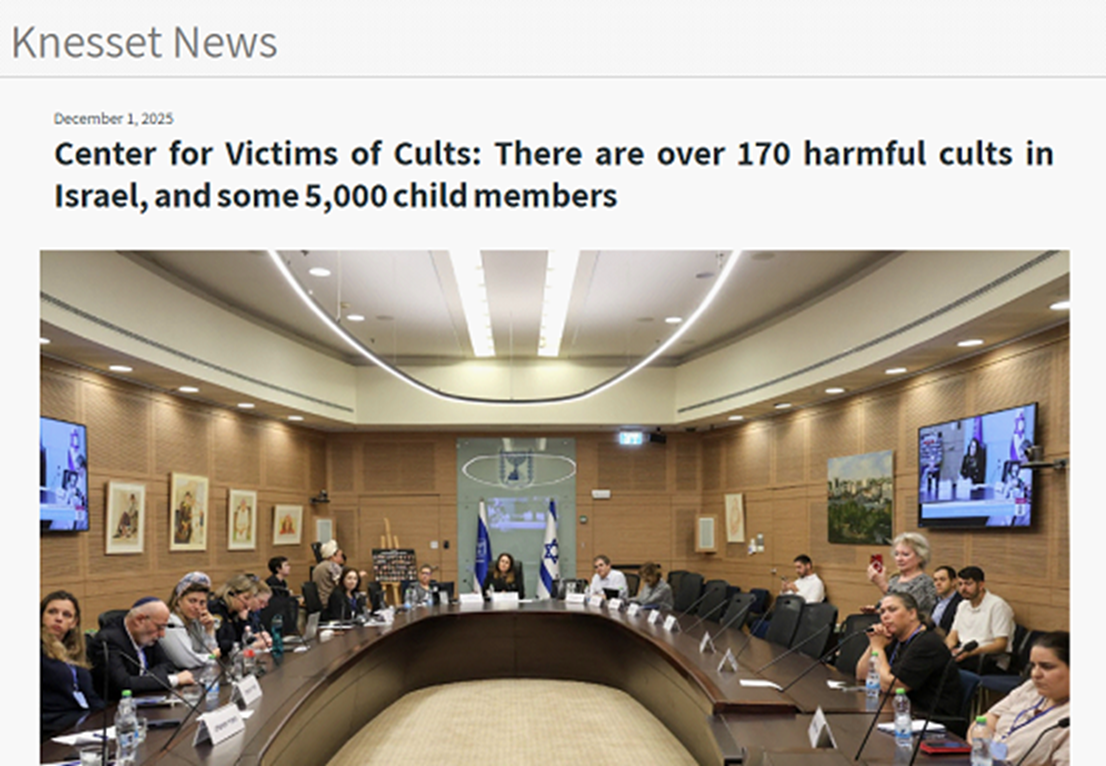
The Special Committee for the Rights of the Child, chaired by MK Kathrin Shitrit (Likud), held on Monday a debate on the manner in which authorities handle children who are harmed by cults in Israel.
Committee Chair MK Shitrit said, "Children who are born and raised in such frameworks - this is their entire reality, which may be one of violence, sexual exploitation, isolation, and total control over their lives. We must honestly admit that the State of Israel has no orderly mechanism dedicated specifically to children harmed by cults. It is unacceptable that we wait for harm to occur rather than initiate active supervision and oversight of closed groups."
Orit, whose nieces and nephews are in the Lev Tahor cult, said she began fighting the cult after her brother took his family and joined it about 15 years ago. "This is a cult with extremely severe criminal activity. Children suffer harsh starvation, they do not eat, they experience rape, beatings, and emotional and physical humiliation. My nieces and nephews were put into homeschooling, which is one of the tools cult leaders use." She argued that enforcement is lacking and that awareness must be raised in schools and other settings, and professionals must be trained to deal with this phenomenon.
The father of a girl who was harmed by a cult said, "Unfortunately, the [Ministry of Welfare and Social Affairs] doesn't know what a cult is. The cult in question is called Shuvu Banim. It is connected to Rabbi Berland, and my ex-wife moved there with my daughter. I was told this cult is a normative community. My daughter dresses and speaks differently."
Asked by Committee Chair MK Shitrit what is wrong with the education the girl receives, and what is harmful, the father replied: "She walks down the street spitting on people she considers immodest. She calls her grandparents 'gentiles.' I approached every authority, and no one helps. What are they waiting for, rape? Abuse? Violence? It seems people are afraid to deal with this."
Rachel Lichtenstein, CEO of the Israeli Center for Victims of Cults, said that today there are over 170 harmful cults and about 5,000 children who are members. "People are afraid to talk about it, but a child living with a cult often disappears from the system because [the cult] leaders want them to disappear. Minors are taught to be isolated and clandestine. These children do not receive treatment in the healthcare systems, and we see cases of neglect and physical harm. They move residences frequently, sometimes abroad. The cults mask their identity through altruistic ideas and community volunteering."
Ilan Sharif, head of the Cult Victims Department at the Ministry of Welfare and Social Affairs, explained that the state has not defined what a cult is and has not regulated treatment of harmful groups except where criminal offenses occur. "As a ministry, we have defined three levels of groups. We regulated two issues that present constitutional difficulties: regulation of a minor in a cult, and assistance to those leaving cults. We are not an enforcement body but a treatment body," he said.
Odia Rubin Ben Zaken from the Ministry of National Security noted that there is no legal framework regulating cults that gives the ministry or the police tools to act unless there are indications of criminal activity.
Ministry of Education official Yafit Hassan, said, "As long as the children are integrated into educational institutions, we provide educational and therapeutic responses as needed." Regarding homeschooling and its oversight, she said there is a structured mechanism to examine learning content and approve applications each time anew.
Adv. Lizo Wolfus from the State Attorney's Office said, "The world of cults is an island beneath everyone's radar. As law enforcement authorities, there is no law prohibiting organizing as a cult, so we need to identify criminal offenses through police complaints to [establish grounds for an] indictment. For example, in the case of the Ambash cult, we used the offense of slavery. I would expect to have a structured inter-ministerial protocol to help us dismantle such cults."
Adv. Sigalit Zohar, Anti-Trafficking Coordinator at the Ministry of Justice, said the ministry provides legal aid to minors, including those harmed by cults. Another Justice Ministry official said, "There are evidentiary difficulties regarding cults, and it is very hard to penetrate and understand what happens inside and prove offenses. This is not a predominantly legislative issue."
She noted that in the past, there was a proposal to prosecute cult leaders similarly to the prosecution of heads of criminal organizations. "There were challenges in using such definitions for criminal purposes. There have been convictions under the offense of forced labor, which is not a simple offense," she said.
In conclusion, Committee Chair MK Shitrit said the committee is concerned that there is no systemic treatment of the issue and asked government ministries to hold a roundtable to advance legislation and examine state responses, including: creating a unit to locate children; reexamining the placement of foster children in Shuvu Banim; collecting data on homeschooling in cults; and reviewing approval procedures.
Source link: https://main.knesset.gov.il/en/news/pressreleases/pages/press11225w.aspx
